

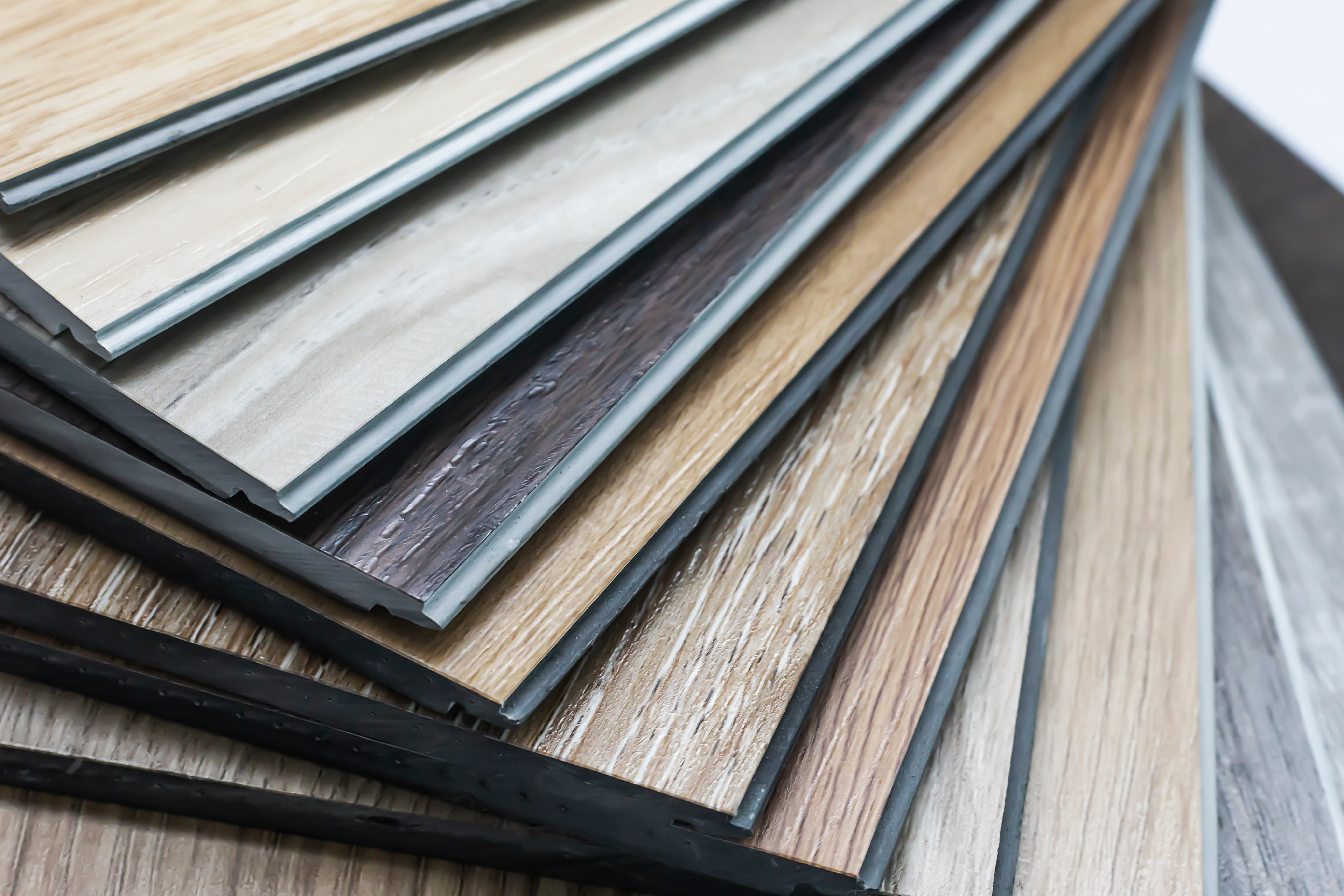
Laminate flooring is installed in one of two ways, and the method used determines how realistic a single board repair actually is. Click lock laminate, the floating floor style where boards snap together along their edges without glue or nails, is far more repair friendly than glued down laminate, where every board is bonded directly to the subfloor. This distinction rarely comes up when a floor goes in, but it becomes the deciding factor the moment a board needs replacing.
Why Click Lock Construction Makes This Possible
Click lock boards connect to each other through a tongue and groove style edge that locks pieces together without adhesive holding them down to the floor beneath. Because the boards are only locked to their neighbors and not glued to the subfloor, a board somewhere in the middle of the room can, in many cases, be worked free from the surrounding boards without disturbing the entire floor.
The realistic part of this process involves the boards between the damaged one and the nearest wall or doorway. Since click lock boards install in a connected sequence, freeing a board in the middle of a room typically means carefully unlocking and relocking the boards between it and the room's edge, rather than lifting the damaged board in complete isolation. An experienced installer can usually do this cleanly, but it does take more time than people expect from what sounds like a simple swap.
Why Glued Down Laminate Is A Different Situation
Glued down laminate does not offer the same flexibility, since every board is bonded directly to the subfloor and removing one typically means cutting it out rather than unlocking it. This process is more invasive and carries a higher risk of damaging the boards immediately surrounding the cracked one, since they were never designed to be separated once installed.
This is not to say a glued down board can never be replaced, but it is a more involved repair, and the outcome depends heavily on how carefully the surrounding area is handled during removal. Homeowners with glued down laminate who are dealing with a single damaged board should expect a more detailed conversation about what the repair actually involves before assuming it will be a quick fix.
What Actually Determines If The Repair Will Look Seamless
Beyond the installation method, the biggest factor in how invisible a repair looks afterward is whether matching replacement boards are still available. Laminate lines get discontinued, and even within the same product line, dye lots can shift slightly in color over time, which means a board pulled from a leftover box after a few years may not match perfectly.
Keeping leftover boxes from the original installation is the single best thing a homeowner can do to make a future repair simple, since it guarantees an exact match rather than relying on tracking down a discontinued style years later. This is worth mentioning to anyone having new laminate installed, since it costs nothing to set a box aside and can save a significant headache down the road.
When A Full Room Replacement Actually Makes More Sense
There are situations where replacing the whole room ends up being the more practical choice, even when a single board repair is technically possible. A floor that already shows wear throughout, one where matching replacement boards are no longer available, or a room with several older damaged spots rather than just one are all situations where a full replacement can make more sense than patching a single visible board.
This is a conversation worth having honestly rather than assuming either direction automatically. A single, isolated crack in an otherwise healthy click lock floor is often a straightforward repair. A floor showing its age throughout the room is a different situation entirely, and pretending a spot fix will look seamless in that case usually leads to disappointment.
Getting An Honest Look At Your Specific Floor
The only way to know whether your cracked board can be replaced on its own is to have someone look at the installation method, the condition of the surrounding floor, and whether matching material is realistically available.
L.A.F Floors & Interiors can evaluate laminate damage for homeowners across Worcester, Shrewsbury, Westborough, Southborough, Northborough, Grafton, and Millbury, MA and give a straightforward answer on whether a single board repair makes sense or whether a different approach would serve the room better.
Visit our showroom in Shrewsbury, MA, one of Shrewsbury, MA, to talk through a laminate repair or explore new flooring options. We proudly serve homeowners across Worcester, Shrewsbury, Westborough, Southborough, Northborough, Grafton, and Millbury, MA. Contact us to have your floor evaluated, or browse our laminate flooring collection if a fresh start makes more sense for your space.

